LIVE PREVIEW · Updated Friday, October 16, 2026 Saturday’s practice and qualifying are pending. Lineups below are candidates for review.
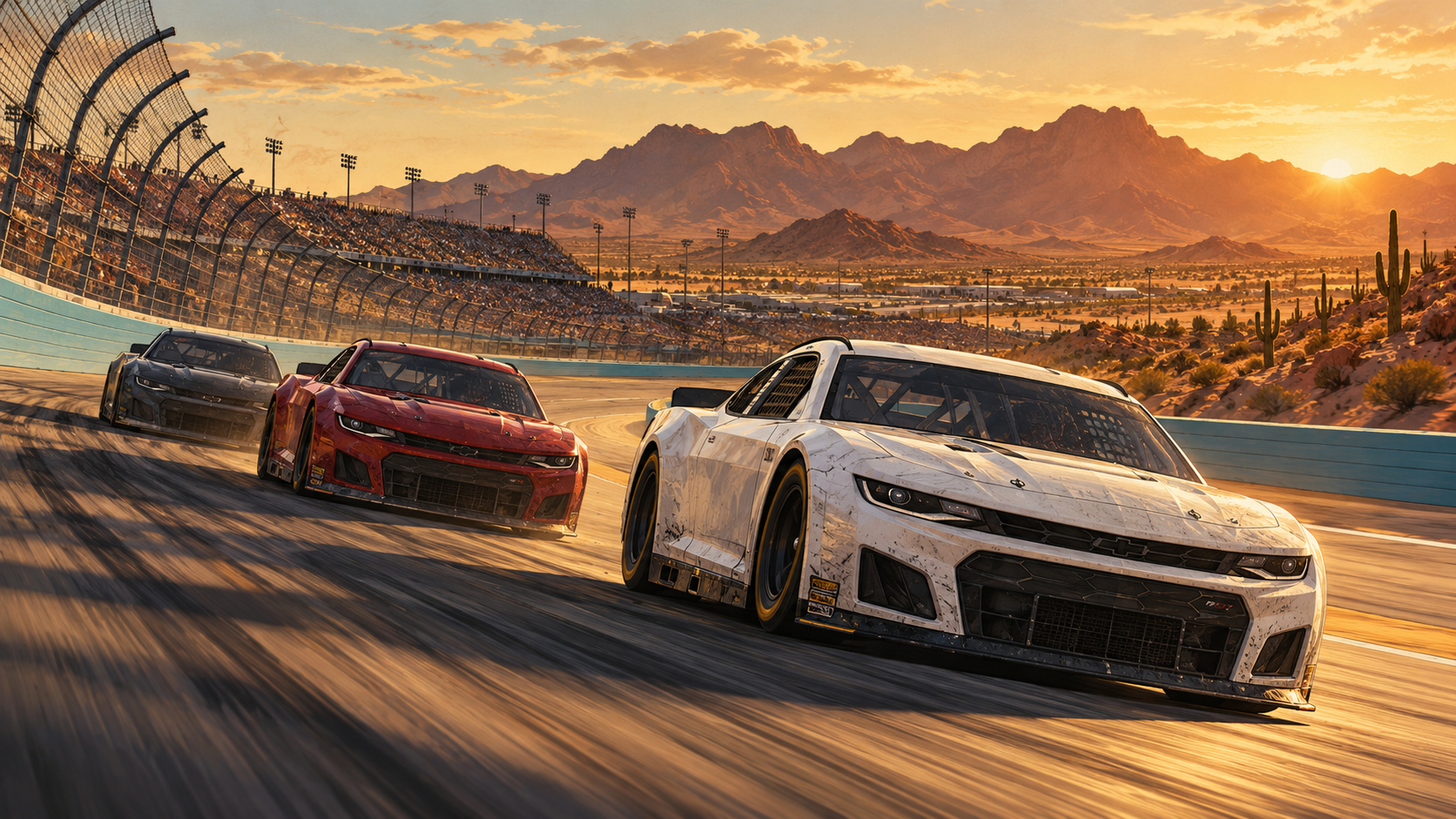
Editorial illustration
Daily Models / NASCAR / O’Reilly Auto Parts Series
Shake & Bank Desert Reset
The trucks set the bar. Now the cars get their turn.
Timberland PRO 200 · Phoenix Raceway Saturday, October 17 · 6:30 p.m. Central · 200 laps · The CW
From the Editor’s Couch
“Rubbin’, son, is racin’.”
After Friday’s Truck race, the garage has a little swagger. The couch remains exactly where it was, and nobody has offered us a headset.
The useful part of Haul Pass was how the six drivers fit together: a credible leading option and a supporting cast with room to move forward. That is the question we’re taking into Saturday. Can we find the right leader without making the other five pay for his parking spot?
Phoenix gives Love, Allgaier and the challengers several ways to score. We’ll compare those routes after practice and qualifying, when “he was cheap” will once again be rejected as a complete scouting report.
Back Through the Garage
Charlotte’s homework, ready for Saturday.
Charlotte gave us three scoring jobs to compare: Love’s lap production, Allgaier’s recovery and Jones’ position gains. Kvapil’s tire trouble, Mayer’s late flat and Crews’ crash belong in the downside review. At Phoenix, we’ll test how each complete six-driver lineup holds together when its main scoring case fails.
The lessons going into Saturday
Give every car a scoring job. Review finish, position gain, laps led and fastest laps separately.
Compare all six drivers. An expensive pair is useful only if its supporting cast makes sense.
Keep another leader route open. Let Saturday’s sustained speed and scored starts challenge the first draft.
Keep the lap budget honest. A late winner does not inherit the laps another driver already led.
Under the Hood
Phoenix gets its own homework.
The spring race is our first stop
In March, Love led 114 laps and finished second. Allgaier led the final 11 to win. Kvapil finished third after leading 22; Creed was fourth with 20 laps led. The trophy and the biggest lap-leading haul belonged to different drivers.
That gives Love and Allgaier complementary research cases. It does not make both automatic at any price or starting spot.
Where the Phoenix points come from
There are 50 lap-led points over 200 scheduled laps. Fastest laps add 0.45 each. The no-caution arithmetic ceiling for both pools is 140 points across the field; actual scored fastest laps can be fewer, and overtime can add laps. Three expensive cars must share that opportunity.
March 7 Phoenix — reconstructed points using reported starts
Driver
Finish + gain
Led
Fast laps
Total
Jesse Love
42
28.50
20.70
91.20
Justin Allgaier
61
2.75
6.75
70.50
Carson Kvapil
52
5.50
12.60
70.10
Sheldon Creed
52
5.00
4.50
61.50
Sam Mayer
46
2.75
1.35
50.10
Sammy Smith
39
2.50
6.75
48.25
Love’s 46 fastest laps helped second place outscore the winner. Allgaier’s 16-place gain did a different job. Those are useful construction lessons, not this week’s point projections.
The tire decisions have a timetable. Stages end at laps 45 and 90 before the 200-lap finish. Keep the earlier lap production when testing a late winner; changing the final restart does not erase the first 190 laps.
Official NASCAR results supply starts, finishes and laps led. Lap Raptor supplies fastest-lap counts; each total above was checked against FRCS. These are historical reconstructions, not verified DraftKings contest scores. Sources and the published point-rate reference are in the Research Drawer.
Friday’s Garage Notes
The paperwork, the forecast and the parts that still need Saturday.
Two names to reconcile
The newer official crew roster lists Nick Sanchez in the No. 87 and Josh Williams in the No. 92. Sanchez also appears in NASCAR’s qualifying order. Use those identities when checking the final DraftKings driver list; the older entry sheet is not the last word.
Friday’s 4:29 p.m. MST NWS update keeps gusty regional winds in the picture into Saturday, with easing later in the day. Light showers are possible Saturday afternoon into Sunday morning, with better chances over higher terrain east of Phoenix.
Our working baseline remains the full 200 laps. Recheck the forecast and actual track conditions before comparing practice runs.
Saturday, all Central: practice 1:00 p.m. · qualifying 2:05 p.m. · race 6:30 p.m. The next edition follows practice and the scored grid, with another garage check planned before the displayed DraftKings lock.
The useful shortlist, without turning every oval into Phoenix.
March 7 Phoenix race — current Phoenix entrants
Driver
Start
Finish
Laps led
Justin Allgaier
17
1
11
Jesse Love
2
2
114
Carson Kvapil
14
3
22
Sheldon Creed
16
4
20
Corey Day
8
9
0
Kvapil has more than a rebound story. At Gateway on this tire pairing, he led 105 laps and finished fifth; Love led 70 and won. Creed finished second and Mayer third. My read: compare the lap ceiling and the finishing role separately before choosing the second expensive car.
Day stays in the conversation. Back-to-back Vegas and Charlotte wins earn attention. His Gateway 33rd followed an accident, so it cannot stand alone as a pace verdict. Phoenix practice must show whether the recent speed travels.
The supporting cars still have to earn the ride
A low price gets a driver onto the research list. It does not buy him a useful starting spot. These two finishes are context; practice, incident notes and the scored grid decide the role.
October 14 salary snapshot · official 2026 finishing positions
Driver / price
Phoenix
Gateway
Saturday’s question
Sam Mayer $8,800
5
3
Compare his finishing ceiling with the cost of another leader.
Sammy Smith $8,100
6
8
A support role still needs the right scored start.
Parker Retzlaff $7,700
14
6
Check whether his start leaves useful room to recover.
Jeb Burton $6,700
7
10
Compare the supported finishing range with cheaper options.
Kyle Sieg $5,800
24
9
Mixed evidence. A Gateway ninth is not a Phoenix forecast.
Jeremy Clements $6,900
11
31
Review the Gateway pit-road incident before judging pace.
Brennan Poole $6,500
27
19
Savings need credible finishing and position-gain support.
Blaine Perkins $5,900
28
20
The supporting-car case must survive qualifying.
Josh Bilicki $5,600
30
26
A low price cannot rescue an unfavorable scored start.
Thompson and Ryan Sieg remain in the wider comparison despite their pit-stall penalty. A stronger case from either can replace a familiar name. Every car still needs a job.
Shake and Bake
Three race stories. Each has a way to score and a way to break.
Love’s leading case
Love Holds the Lane
The story: Love’s lap-leading case gets Creed alongside him, Sammy Smith in the middle, and three drivers who need credible finishing and position-gain opportunities.
Six-driver lineup · $48,600
Jesse Love$11,500
Sheldon Creed$9,800
Sammy Smith$8,100
Jeremy Clements$6,900
Brennan Poole$6,500
Kyle Sieg$5,800
$48,600 total$1,400 unused
October 14 prices · practice and grid pending
The value check: Clements and Poole need enough room to move forward. Kyle Sieg’s ninth at Gateway supports a closer look at $5,800. Compare Creed with Kvapil for the second premium role: changing only that slot makes this same six-driver structure $49,300. Both need Saturday evidence.
What breaks it: Love’s long-run pace must support the leading role; qualifying can overturn the value trio.
Allgaier + Love
Allgaier Comes Through
The story: Allgaier and Love share the premium core in this candidate. Four supporting cars make the core affordable; each still needs a useful scored start and credible finishing pace.
Six-driver lineup · $49,400
Justin Allgaier$13,000
Jesse Love$11,500
Brennan Poole$6,500
Jeremy Clements$6,900
Josh Bilicki$5,600
Blaine Perkins$5,900
$49,400 total$600 unused
October 14 prices · practice and grid pending
The value check: Allgaier’s actual start must support the comeback story. Poole, Clements, Bilicki and Perkins need realistic gains, rather than assumed gains.
What breaks it: If Allgaier starts high and lacks a large lap-leading case, rebuild the whole lineup. Don’t carry the comeback story into a front-row start.
The challenger route
The Last Restart
The story: Kvapil earns early lap opportunities, Day supplies the late winning case, and Mayer gives us a third fast-car route. Alfredo and Jeb Burton add spring Phoenix top-ten evidence.
Six-driver lineup · $48,600
Corey Day$10,000
Carson Kvapil$10,500
Sam Mayer$8,800
Anthony Alfredo$7,000
Jeb Burton$6,700
Josh Bilicki$5,600
$48,600 total$1,400 unused
October 14 prices · practice and grid pending
The value check: Bilicki must have a useful start relative to his finishing range. Check all three expensive cars against one shared 200-lap budget.
What breaks it: Practice fails to support the challengers, or too much of the scoring case depends on all three taking clean air.
These are provisional six-driver candidates using the October 14 salary snapshot. All pass the $50,000 cap and roster checks. They have not been ranked by projected points or validated against the future scored grid. The stories can overlap; no simulated probabilities or ownership estimates are assigned.
Don’t Put the Whole Day in One Car
Different names still need to make a good lineup.
We’ll first compare the best complete lineup for each story. Then we’ll review how often the same cars appear, which pairs depend on the same outcome, and what happens if a primary leader loses its race. Exposure limits should have a reason; they should not make a weak sixth car look useful.
The current prices make Allgaier + Love + Day a $34,500 core. Its remaining $15,500 forces Cram and Smithley alongside either Scott or Perez. That combination needs a convincing supporting-car case before it earns a place. The examples above leave salary unused while we compare that tradeoff. A deep start still needs a car that can finish.
Gentlemen, Check Your Lineups
Saturday’s grid gets the final say.
After qualifying: match DraftKings’ scored starting positions, current drivers and prices. Reconcile any rear-of-field announcement with that scored grid before assigning position gains. Check six unique drivers and the $50,000 cap.
Before the displayed lock: compare consecutive practice runs at similar tire age and conditions, noting traffic and run length. Then refresh inspection, backup cars, weather, tire notes and any revised race schedule.
After every revision: compare the old and new scoring case, then recalculate the whole portfolio. A comfort swap still needs evidence.
The Research Drawer · Updated October 16, 2026
The October 14 DraftKings salary export, current entry report, March Phoenix and September Gateway results, Charlotte’s final classification and the October 13 tire release underpin the provisional lineups. Friday’s official driver paperwork, current forecast and Haul Pass model review inform the update. The spring scoring reconstruction adds fastest-lap counts from Lap Raptor, independently cross-checked against FRCS. Published DraftKings NASCAR fantasy-point rates corroborate the arithmetic; this slate’s own Rules & Scoring screen still needs a final check. No verified ownership forecast or calibrated race simulation is in use. The three price-checked examples will be rebuilt after practice and the scored grid.
NASCAR’s current weekend schedule confirms practice starts Saturday at 1:00 p.m. Central, qualifying at 2:05 p.m. and the race at 6:30 p.m. Verify the latest timetable before race day. DraftKings’ displayed lock controls lineup edits.